Trenching and utilities
Utility work combines excavation with locating, shoring, lifting, pumping and reinstatement. The right plant choice is often governed by corridor width, live services and public access rather than bucket capacity alone.
Read the whole workface.
Trenching for water, sewer, stormwater, gas, power and telecommunications is controlled by what is already in the ground. Service locating, potholing and permits usually decide the excavation method before bucket size is discussed.
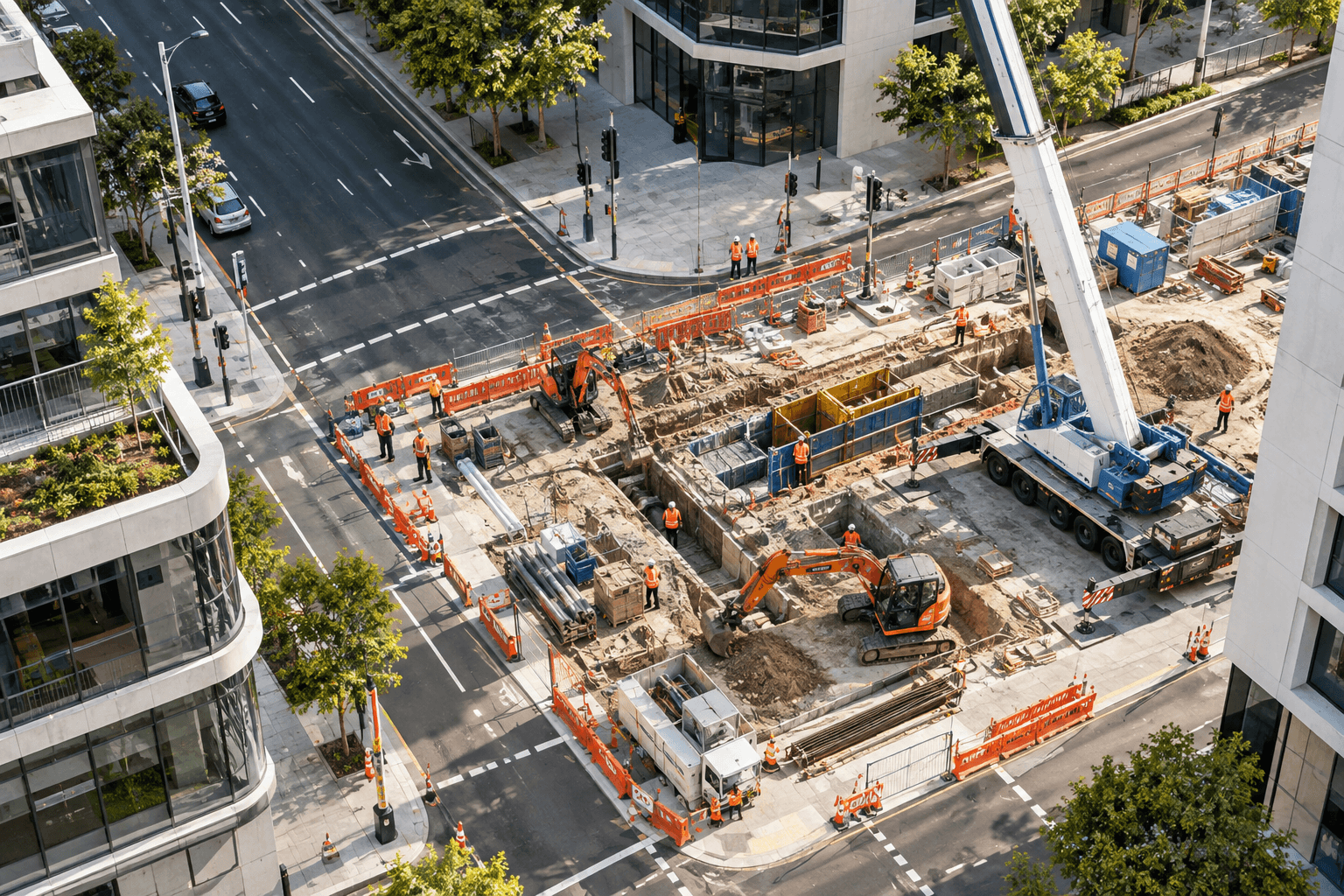
Plant selection follows trench width, depth and the working corridor. Mini and midi excavators suit most urban services; vacuum excavation proves live assets; trench shields or shoring protect workers; and plate compactors or rammers finish the backfill. Pumps may be needed if groundwater or rain enters the trench.
Reinstatement specifications—pavement, footpath, turf or road—often drive the tail end of the fleet. Include traffic control, spoil removal and material delivery in the same brief.
Machines most often involved: mini excavator hire, excavator hire, plate compactor hire, pump hire, tipper truck hire, traffic control equipment hire.
Three questions that expose the gaps.
- What remains live?
- How is the excavation protected?
- What is the reinstatement specification?
Trenching and utilities: questions
- What size excavator is best for trenching?
- Residential services usually use a 1.7–5 t mini excavator. Civil pipelines and larger services often use a 13–20 t machine. Trench depth, width, pipe weight and corridor space decide the size.
- When is trench shoring required?
- Work health and safety rules require excavations to be protected against collapse where there is a risk to workers, commonly at depths of 1.5 m or more. A competent person should determine the method.
- Do I need Before You Dig information?
- Yes. Request asset information before any excavation, then locate and prove services on site before mechanical digging near them.