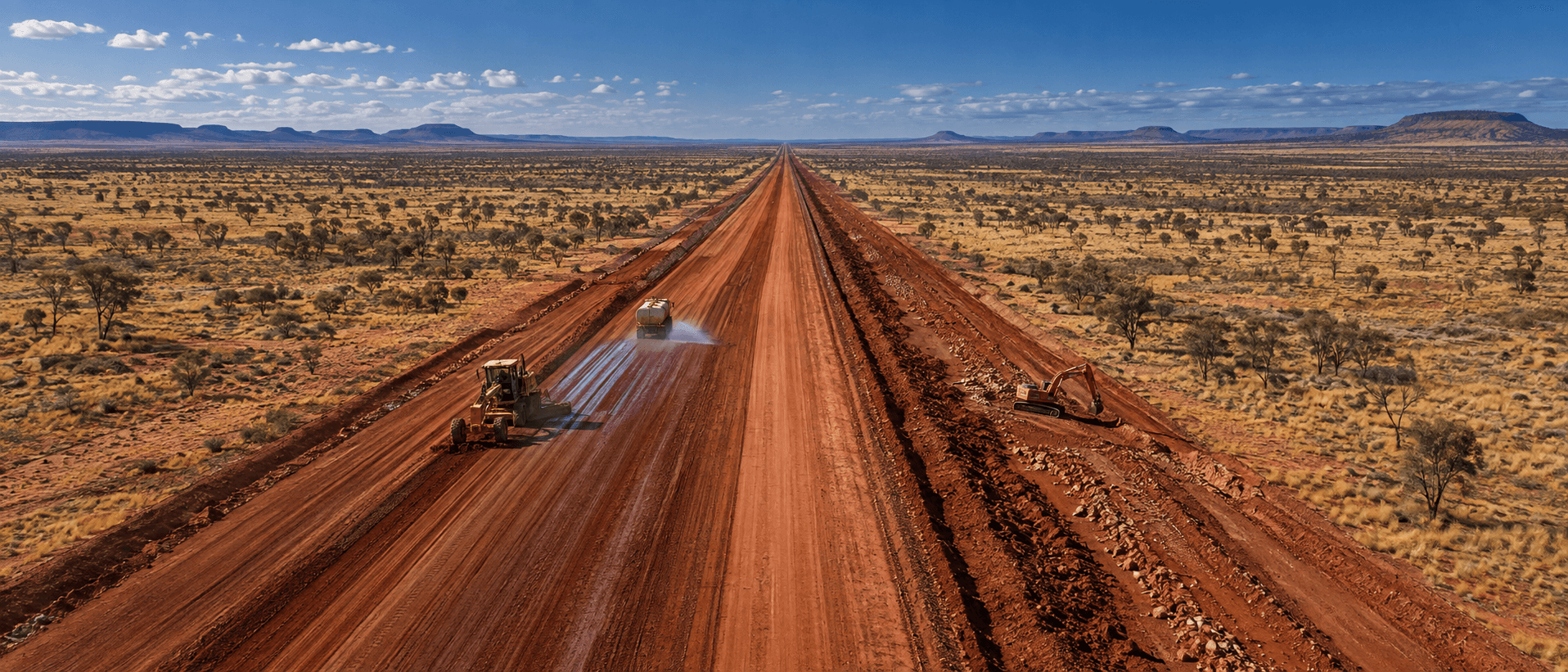
Road building
Road crews need repeatable passes and predictable support across a moving workfront. Match graders, rollers, water carts and paving support to material layers, width, moisture and test requirements.
Read the whole workface.
Road construction builds pavement in layers—subgrade, subbase, base and surfacing—each with its own compaction and level tolerance. The fleet moves along the corridor, so plant must be able to relocate efficiently between work fronts.
A typical road crew pairs graders with water carts and rollers, supported by tipper trucks, a loader and sometimes a stabiliser or profiler. On live roads, traffic control equipment and lighting towers for night shifts are part of the core plant list.
Testing hold points shape the daily rhythm. Confirm who arranges density testing, how failed lots are reworked and how weather affects the programme.
Machines most often involved: grader hire, roller hire, water truck and water cart hire, tipper truck hire, traffic control equipment hire, lighting tower hire.
Three questions that expose the gaps.
- How long is the active front?
- Where can plant turn?
- What proof testing is required?
Road building: questions
- What equipment is used to build a road?
- Graders, rollers, water carts, tippers, loaders and sometimes stabilisers, profilers and pavers, supported by traffic control and survey.
- Why are water carts so important in road building?
- Pavement materials compact properly only at the right moisture content. Water carts deliver that moisture and suppress dust.
- Can road plant work at night?
- Yes, with lighting towers, approved traffic management and noise controls. Night work is common on busy roads.